

Report By: Ishmael Barfi
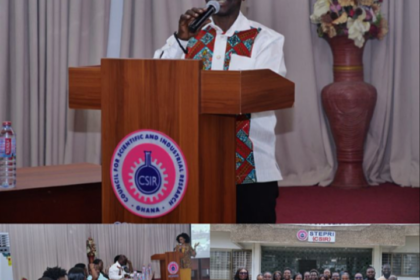
Accra, Ghana – The Ghana Meteorological Agency (GMet) has launched Ghana’s first Climate Atlas, a groundbreaking tool that provides climate projections for the next 150 years. The atlas, developed in collaboration with the Danish Meteorological Institute, offers high-resolution forecasts for precipitation, temperatures, and sea level rise, with a resolution of four kilometers.
In an exclusive interview with Climate Watch, the Director-General of GMet, Dr. Eric Asuman, emphasized the importance of the Climate Atlas, saying, “Our life and livelihoods are affected by weather and climate. Decisions we take today should address future weather and climate conditions. And if you don’t know those future weather and climate conditions, you’ll make decisions now, but by the time we get there, the conditions would have changed, making today’s decisions useless.”
The Climate Atlas provides interactive data on temperature, precipitation, and sea level rise, allowing policymakers, organizations, and individuals to plan for the future.
Dr. Asuman explained, “If a local district or assembly engineer is designing a drainage system, they can use the atlas to determine how rainfall patterns will change in the next 15 years and design a system that can accommodate the projected runoff”.
Adding “When we do that, it makes our investment worth it, because we’re investing for tomorrow, and you’re investing to deal with the resilience that are coming or extreme weather events that can come tomorrow or years to come.”
The atlas is a significant improvement over previous global and regional models, which had resolutions of 50-100 kilometers.
Dr. Asuman noted, “We’ve adapted the Climate Analysis to Ghana and the community level, allowing us to plan at the district level. Even within Ghana, we’re not dealing with the entire country as a single entity with one average. We can go to the district assemblies and get data on each district, showing how the climate affects that district and how projections will affect it in 50 or 100 years.”
The Climate Atlas is expected to inform decision-making in various sectors, including infrastructure development, agriculture, and urban planning.
Dr. Asuman urged stakeholders to utilize the atlas, saying, “It’s for policymakers to inform planning, for organizations to incorporate weather and climate data into their long-term plans, and for individuals to consider how weather and climate will affect them in the next 50, 100, or 30 years. And so it’s a very critical information.”
The launch of the Climate Atlas marks a significant milestone in Ghana’s efforts to address climate change and promote sustainable development.
Source: www.climatewatchonline.com