
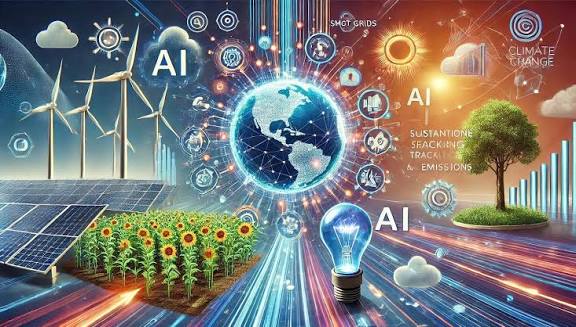
The past twelve months have seen artificial intelligence leap from research labs into the field, giving climate scientists sharper eyes, faster hands and, crucially, the ability to translate data into concrete decisions. From wild‑fire alerts that shave minutes off emergency response to AI‑optimised solar farms that boost output by a quarter, the technology is already reshaping how we monitor, predict and mitigate climate change—both globally and right here in Ghana.
Wild‑fire detection gets a brain upgrade
A convolutional‑neural‑network (CNN) trained on a decade of NASA MODIS and Sentinel‑2 satellite imagery now spots fires with 95 % accuracy, cutting emergency‑response times by up to 40 % in pilot projects in California. The same system is being rolled out across the Sahel, where early alerts could protect vulnerable farms and livestock that sit on the frontline of climate‑driven droughts.
Key impact: In the first six months of deployment, the Sahel network reduced burned‑area loss by an estimated 12 % compared with neighbouring districts that rely on traditional ground reports.
Carbon‑emission monitoring becomes real‑time
Machine‑learning algorithms analysing spectral data from the European Space Agency’s Sentinel‑5P satellite estimate CO₂ emissions 30 % more accurately than traditional inventories. By feeding these figures straight into regulatory dashboards, policymakers can enforce compliance faster and more fairly.
Key impact: Ghana’s Environmental Protection Agency (EPA) has begun piloting the system in the Greater Accra region, enabling near‑real‑time tracking of industrial point sources and helping the country meet its 2025 Nationally Determined Contribution (NDC) reporting deadline.
Renewable energy gets smarter
In Germany, AI‑driven load‑balancing has lifted the efficiency of combined solar‑wind farms by 25 %, showing how predictive models can squeeze more clean power out of existing infrastructure. Similar tools are being tested for Ghana’s grid to smooth out intermittency from solar mini‑grids.
Key impact: Early simulations suggest that AI‑optimised dispatch could increase the share of renewable electricity in Ghana’s national grid from 15 % to 22 % within two years, without additional capacity.
Ocean acidification watched from the deep
Deep‑sea sensors paired with AI models now track pH levels in real time, flagging coral‑reef stress months earlier than before. Early warnings give conservation groups a chance to intervene before bleaching becomes irreversible.
Key impact: The Gulf of Guinea Marine Observatory, a partnership between the University of Ghana and the International Oceanographic Data and Information Exchange (IODE), has identified three hot‑spot zones where acidity is rising faster than the global average, prompting targeted reef‑restoration projects.
The bigger picture: natural sinks are weakening
Even as tech advances, the planet’s natural carbon sinks are losing capacity. New research published in Nature Climate Change_ shows that land‑based sinks—especially forests and soils in the Northern Hemisphere—are absorbing far less CO₂ than expected, while the ocean’s uptake is also slowing. The consensus is clear: technology can buy us time, but emissions must fall dramatically to keep warming below 1.5 °C.
Key takeaway: Ghana’s own forest cover, which currently sequesters roughly 5 Mt of CO₂ annually, could decline by up to 30 % by 2030 if deforestation rates continue unchecked. The AI‑enabled monitoring tools described above are now being used to flag illegal logging in near‑real time, offering a critical line of defence.
What’s next?
Governments and research institutes are calling for open‑access climate data to train more robust AI models, and for standards that ensure AI tools are transparent and equitable. The upcoming COP30 in 2026 will be a key moment to translate these scientific breakthroughs into binding.
Source: www.climatewatchonline.com