
Accra, Ghana — As Ghana intensifies efforts to achieve net-zero carbon emissions by 2070, a researcher at the National Centre for Earth Observation and Climate (NCEL) is developing solutions to strengthen the country’s greenhouse gas (GHG) reporting systems and improve the quality of climate data used for policymaking.
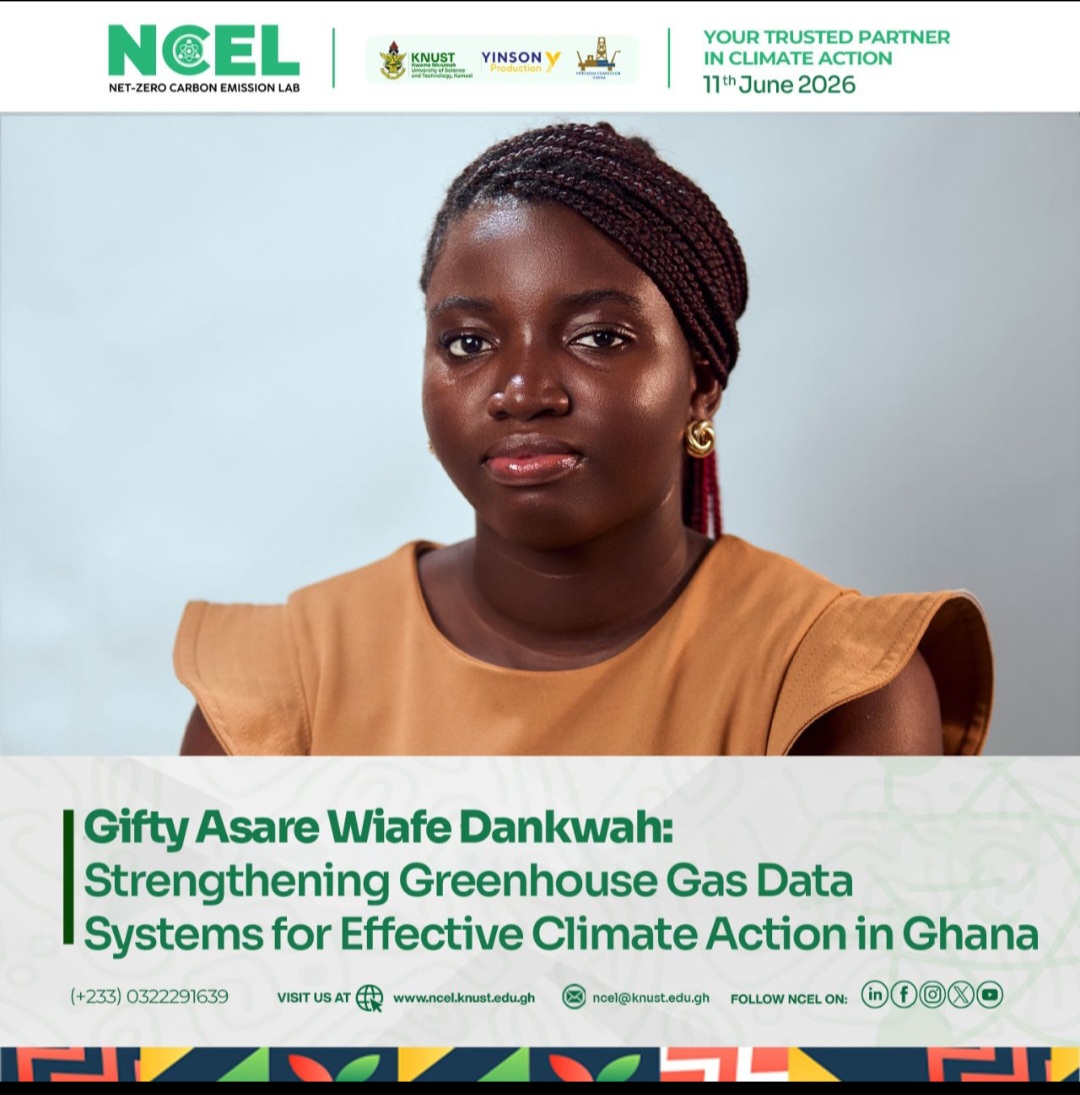
Gifty Asare, an MPhil scholar at NCEL, is conducting research focused on greenhouse gas inventory development and data harmonization, aimed at improving how emissions data are collected, integrated, and managed across institutions.
Reliable greenhouse gas inventories form the foundation of climate action, helping countries track emissions, assess progress toward climate targets, and fulfill international reporting obligations under the Paris Agreement. However, compiling accurate inventories remains a challenge because emissions data are often generated by multiple institutions using different methodologies, reporting formats, and timelines.
These inconsistencies can create data gaps, duplication, and discrepancies that undermine the accuracy and credibility of national emissions reporting.
To address this challenge, Asare’s research seeks to develop approaches that enhance the organization, integration, and management of emissions data from diverse sources, creating a more coherent and transparent reporting system.
Her work focuses on strengthening the data infrastructure that underpins Ghana’s greenhouse gas inventories, with the goal of improving consistency, transparency, and confidence in the country’s climate reporting processes.
Climate experts note that robust and harmonized data systems are becoming increasingly important as countries scale up climate action and seek to align national development strategies with global climate commitments.
By improving the quality and accessibility of emissions data, the research is expected to support evidence-based decision-making, strengthen climate governance, and enable more effective planning for mitigation and adaptation measures.
The study also contributes to broader efforts to enhance institutional coordination and data-sharing mechanisms among agencies responsible for generating and managing climate-related information.
As Ghana advances its climate agenda, researchers and policymakers alike recognize that reliable data systems will be critical to measuring progress, attracting climate finance, and ensuring accountability in the country’s transition toward a low-carbon and climate-resilient future.
Source: www.climatewatchonline.com