
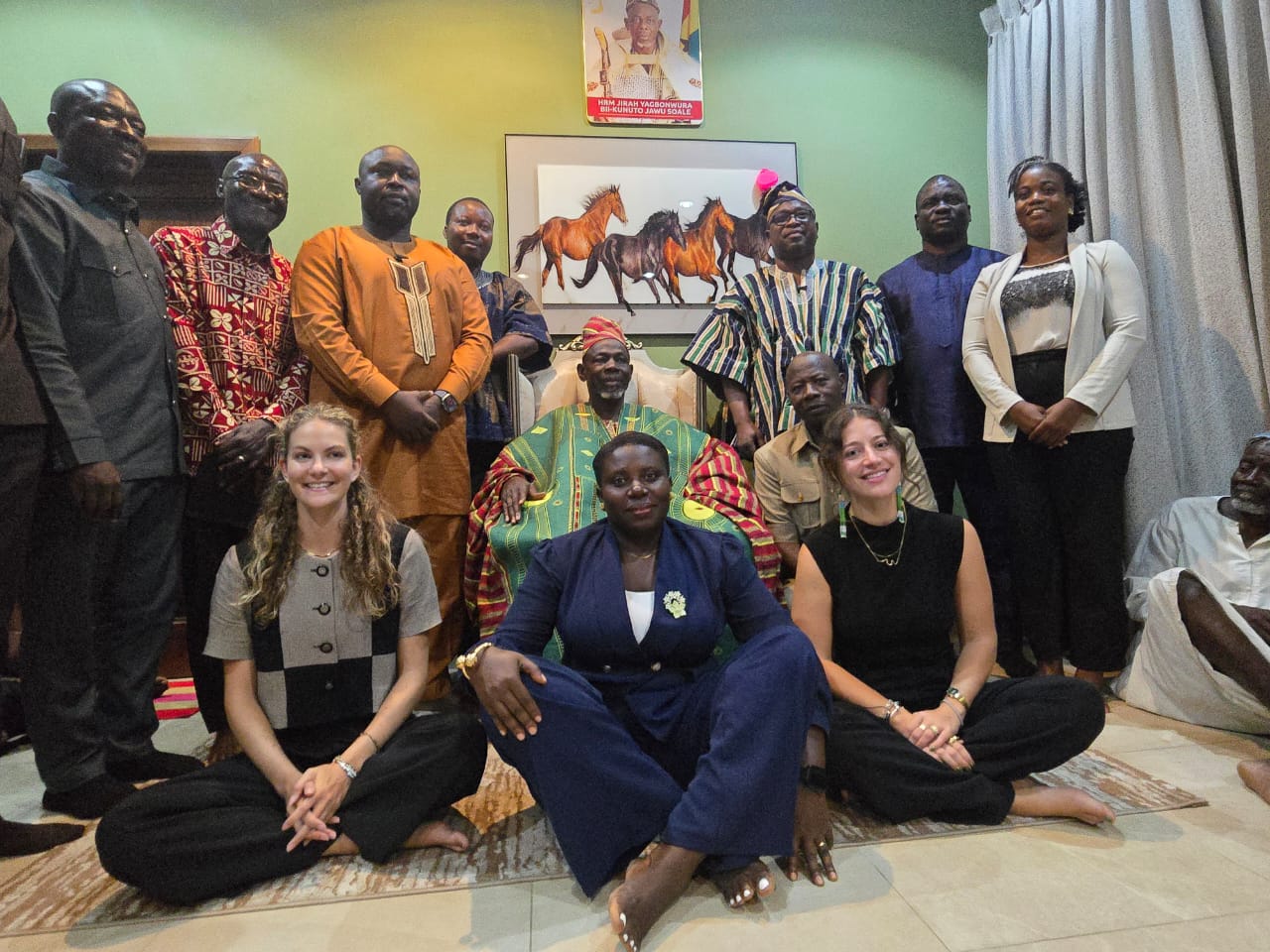
The Government of Ghana has reaffirmed its commitment to building an inclusive and decentralized climate governance system through a strategic engagement with traditional authorities, beginning with a high-level courtesy call on the King of Gonjaland, Yagbonwura Bikunuto Jewu Soale I, by the Minister of State for Climate Change and Sustainability, Hon. Seidu Issifu, in the Savannah Region.
The visit formed part of the Minister’s official regional engagement in Northern Ghana and underscored the growing recognition that traditional leadership remains indispensable in addressing climate change and advancing sustainable development.
Accompanying the Minister were the Savannah Regional Minister, Hon. Salisu Be-Awuribe; the Savannah Regional Coordinating Director; Metropolitan, Municipal and District Chief Executives from across the region; representatives of the Regional Coordinating Council; officials from the Ghana Meteorological Agency; and representatives of the Global Centre for Climate Mobility.
The delegation paid the courtesy call to seek the blessings of the Yagbonwura and solicit the support of the Gonja Traditional Council for the regional stakeholder consultations on climate change and sustainability.

The Savannah Region engagement marks the beginning of a broader regional consultation exercise across the five northern regions of Ghana; Savannah, Upper West, Upper East, North East, and Northern Regions. Designed to strengthen climate governance and deepen stakeholder participation in shaping Ghana’s climate future.
Building Ghana’s Climate Governance Architecture
The regional consultations form part of a national initiative being led by the Office of the Minister of State for Climate Change and Sustainability to strengthen Ghana’s institutional framework for climate governance through stakeholder consultation, capacity building, and awareness creation.
The consultations are expected to lay the foundation for two landmark institutional reforms: the establishment of a National Climate Change and Sustainability Hub and the creation of Climate Change and Sustainability Units within Ministries, Departments and Agencies (MDAs), as well as Metropolitan, Municipal and District Assemblies (MMDAs).
The engagements are also intended to enhance awareness and practical application of the Ghana Climate Atlas as an evidence-based planning tool while strengthening regional ownership of climate governance initiatives and promoting collaboration among government institutions, traditional authorities, development partners, academia, civil society, and the private sector.
Traditional Leadership as Partners in Climate Action
Addressing the gathering, the Yagbonwura reaffirmed the commitment of traditional authorities to supporting national development initiatives, particularly those aimed at safeguarding the environment and protecting future generations.

“Traditional leadership has always been the custodian of our lands, forests, water bodies and cultural heritage. We therefore stand ready to work hand in hand with Government because protecting the environment is not only a national responsibility, it is our sacred duty to future generations.”
The Paramount Chief further pledged the support of the Gonja Traditional Council towards the successful implementation of climate and sustainability initiatives across the Savannah Region.
Regional Commitment to Success
Savannah Regional Minister Hon. Salisu Be-Awuribe welcomed the initiative and assured the Minister of the full commitment of the Regional Coordinating Council, the Metropolitan, Municipal and District Assemblies, and all regional stakeholders.
“The Savannah Region is fully committed to working closely with the Office of the Minister of State for Climate Change and Sustainability, our traditional authorities, development partners and all stakeholders to ensure that the objectives of this engagement translate into practical actions that improve livelihoods and strengthen climate resilience across our communities.”

He noted that collaborative leadership would be essential in ensuring climate interventions respond effectively to the unique environmental challenges confronting northern Ghana.
Climate Solutions Must Be Rooted in Communities
Speaking during the engagement, Hon. Seidu Issifu emphasized that climate governance cannot succeed without the active participation of traditional institutions, whose influence, knowledge and stewardship remain vital to sustainable natural resource management.
“Traditional leaders are not merely custodians of our culture, they are custodians of our ecosystems. Lasting climate solutions must be rooted in our communities, guided by indigenous knowledge and strengthened through partnerships between Government and traditional leadership. Together, we can build a climate-resilient Ghana that leaves no community behind
The Minister explained that the nationwide consultations are designed to ensure that every region contributes meaningfully to the design of Ghana’s emerging climate governance architecture, enabling locally driven solutions to complement national policy.
A National Journey Towards Climate Resilience
As Ghana continues to confront the realities of climate change including rising temperatures, prolonged droughts, floods, land degradation and threats to food security, Government’s engagement with traditional authorities signals a renewed commitment to inclusive governance and shared responsibility.
The ongoing consultations are expected to generate broad stakeholder consensus, strengthen institutional coordination, improve climate planning at national and local levels, and accelerate the implementation of Ghana’s climate commitments under the Paris Agreement and the Sustainable Development Goals.
The courtesy call on the Yagbonwura therefore represents far more than a ceremonial visit. It reflects a strategic partnership between Government and traditional leadership, demonstrating that Ghana’s journey toward climate resilience will be built not only through sound policies and institutions, but also through the wisdom, leadership and enduring influence of its traditional authorities.
Cedric Dzelu
Technical Director
Office of the Minister of State for Climate Change and Sustainability
Source: www.climatewatchonline.com