
News Desk Report
Young Africans from across the continent call for water to sit at the center of climate adaptation, as COP31 seeks to turn past promises into delivery
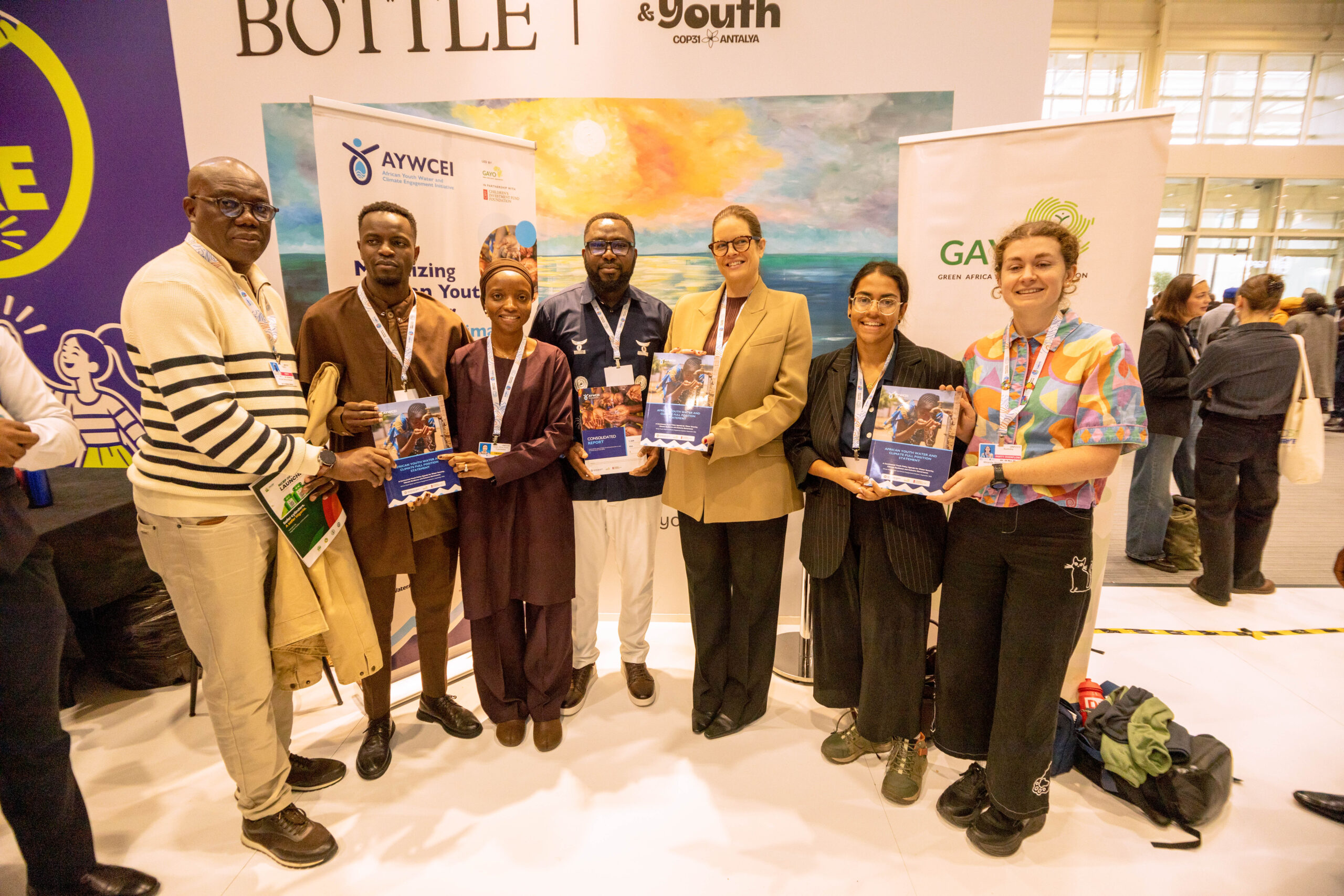
ANTALYA, Türkiye, 18 November 2026. African young people are bringing a continental body of evidence on water and climate to COP31, and asking leaders to make water central to how the world plans and pays for adaptation.
The call comes from the African Youth Water and Climate Engagement Initiative (AYWCEI), led by Green Africa Youth Organization (GAYO) with support from the Children’s Investment Fund Foundation (CIFF). The initiative surveyed 1,209 young people in 51 African countries and held five sub-regional consultations with 984 participants across West, Central, East, North and Southern Africa.
The findings are stark. 76% of young respondents say they have no real say in water and climate decisions. 52% say their community is poorly equipped to cope with climate impacts. 29% have lost, or are losing, a livelihood that depends on water.
Young people’s own accounts show who carries the burden. “The young girls in my community are mostly affected, as they are laden with the responsibility of fetching water from neighboring communities or even a farther location. A girl was discovered pregnant after an alleged assault on an occasion she went to fetch water from a neighboring village. Farmers in my community are also affected,” said Emmanuella Chukwudi, a young participant from Nigeria.
“What we’re trying to understand is what the current water challenges are on the continent of Africa and how young people are responding to this problem,” said Baliqees Salaudeen-Ibrahim, Climate Director at GAYO. She said GAYO intends to identify youth-led water solutions that are bankable, scalable and replicable, and to mobilize resources to support them.
The evidence was presented at a COP31 side event, Water Stress in a Changing Climate: From Youth Evidence to Actionable Solutions for Africa, at the Children and Youth Pavilion.
Funding remains a gap: only 9% of respondents know of a youth-led initiative that has been funded. CIFF says young people are already acting on these challenges. “They have actions that they’re taking in their communities, so we’re trying to show how young people are driving solutions, not just talking about solutions,” said Kate Hampton, Chief Executive Officer of CIFF.
COP31 runs from 9 to 20 November 2026 at the Antalya Expo Center. African negotiators have called for an “implementation COP” focused on predictable finance for adaptation, with water-related issues as a key focus.
Next, AYWCEI will carry the same evidence to the 2026 UN Water Conference in Abu Dhabi, 8 to 10 December, where governments and partners will meet to speed up progress on Sustainable Development Goal 6, clean water and sanitation for all. From there, it goes on to COP32 in Addis Ababa in 2027, with a focus on community-led solutions that can be funded and scaled.
For communities facing water insecurity, the next step is turning this evidence into practical, funded action. AYWCEI’s African Youth Water and Climate Position Statement sets out 12 youth priorities on water security, sanitation, adaptation, adaptation finance and water governance. The Position Statement, policy brief, Consolidated Continental Report and five regional reports are available at greenafricayouth.com/aywcei.
Source: www.climatewatchonline.com