
Report By: Ishmael Barfi
The Green Africa Youth Organization (GAYO) is targeting a fourfold increase in its monthly organic waste collection, from 50 tonnes to 200 tonnes by the end of 2027, as it intensifies efforts to reduce methane emissions and promote sustainable waste management across municipalities in Ghana.
The target is part of GAYO’s Zero Waste Cities Project, which seeks to divert organic waste from landfills through source separation, organised collection and processing into valuable products, including compost and black soldier fly larvae.
As part of the expansion, the organisation has taken its market sensitisation campaign to the La Nkwantanang-Madina Municipality to educate traders on proper waste segregation and encourage the separation of organic waste for collection and processing.
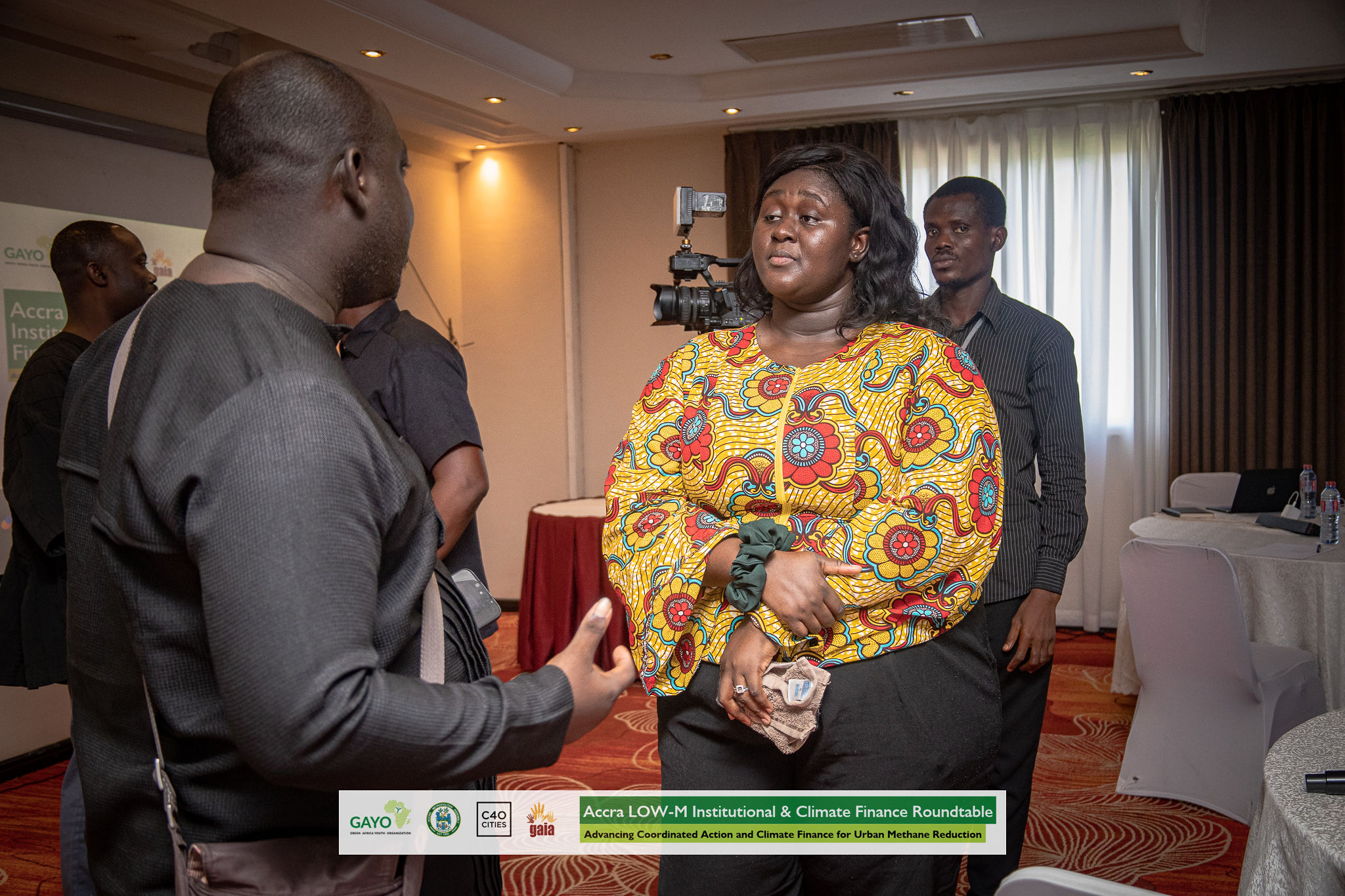
Speaking during the exercise, Fathia Selasi Chaway-Glover, Project Coordinator for GAYO’s Zero Waste Cities Project, said the engagement was designed to introduce market women to the principles of source separation and equip them with practical skills to distinguish organic waste from other materials.
She said participants were taken through demonstrations on how to separate waste at source and identify the materials suitable for organic waste processing.
According to her, the initiative represents an important step towards expanding organic waste collection in the municipality and reducing the volume of biodegradable waste sent to landfills, where its decomposition contributes to methane emissions.
Chaway-Glover explained that the project, supported by the Global Methane Hub and the UMI Fund, builds on GAYO’s existing organic waste management model, which the organisation intends to replicate and expand in other municipalities.
She cited the material recovery facility in the La Dade-Kotopon Municipality as an example of the project’s progress, noting that it currently diverts up to 50 tonnes of organic waste monthly.
GAYO intends to build on this achievement by strengthening its collection systems and extending the model to additional municipalities.
“Our idea is to be able to scale and increase our collection from 50 tonnes per month to 200 tonnes per month by the end of 2027,” she said.
Partnerships to strengthen waste collection
To ensure the effective collection of segregated organic waste, GAYO is collaborating with the Federation of Informal Sector Waste Workers Associations of Ghana (FISWAG) and other private sector organisations.
Chaway-Glover said these partnerships would help establish a reliable collection system, connecting market traders and other waste generators to the facilities where organic materials would be processed.
She stressed that the sensitisation exercise was not a one-off intervention but part of a sustained programme that GAYO plans to replicate as its operations expand across the country.
“Organic processing is a strong part of our Zero Waste Project, and so this is not a one-time, one-touch project. This is actually a proven project that we are replicating and expanding as our reach also grows within the country,” she said.
Organic waste to support agriculture and food resilience
Beyond reducing landfill waste and methane emissions, GAYO is seeking to demonstrate how discarded organic materials can be transformed into resources that support agriculture and food production.
Chaway-Glover said the organisation, as a non-profit, was not primarily driven by profit from the collection and processing of organic waste.
She explained that GAYO has traditionally converted collected organic waste into compost, which it donates to farmers to support soil improvement and agricultural production.
The organisation has so far donated compost to more than 200 farmers across different municipalities, including La Nkwantanang-Madina and Korle-Klortey among others.
GAYO plans to extend this support in La Nkwantanang Madina through compost production for local farmers and an urban gardening initiative.
Chaway- Glover said the intervention would demonstrate how organic waste could contribute to food resilience within the municipality while helping farmers improve agricultural yields through the use of organic compost.
“The idea is to prove the feasibility of turning this waste to support food resilience within the municipality,” she said.
She added that the project would also challenge the perception of food waste as having no further value by demonstrating its potential for conversion into useful agricultural products.
According to her, compost and black soldier fly products provide practical opportunities to recover value from organic waste and support agriculture in Ghana.
Through the Zero Waste Cities Project, GAYO is combining waste diversion, methane reduction and resource recovery while strengthening collaboration among municipal authorities, market traders, informal waste workers and private sector organisations.
The organisation hopes that expanding source separation and organic waste processing will help build more sustainable waste management systems and demonstrate how materials often discarded as waste can be put to productive use.
Source: www.climatewatchonline.com