

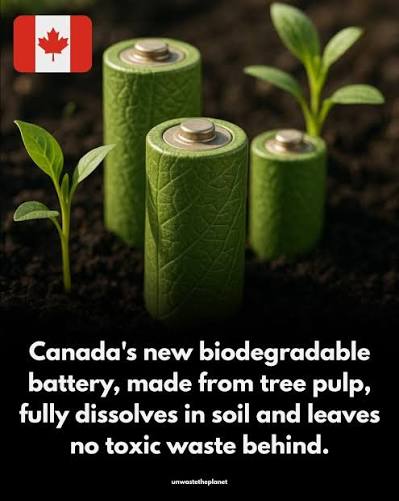
OTTAWA, Canada —Researchers are exploring a new generation of biodegradable battery technologies that could help reduce the growing environmental burden associated with disposable electronics and electronic waste.
The emerging technology uses renewable materials, including cellulose derived from plant and wood-based sources, to develop battery components that can degrade after their useful life.
The innovation reflects a growing shift in clean-technology research towards designing electronic products with their entire life cycle in mind—from production and use to disposal.
Canada’s National Research Council (NRC) has previously worked with industry partners to develop printable, environmentally friendly batteries using biodegradable materials. Researchers developed prototypes with more than 90 per cent compostable content and designed the technology for applications where conventional disposable batteries create environmental concerns. ([National Research Council Canada][1])
Rethinking disposable electronics
Conventional batteries can create environmental challenges when improperly discarded, particularly because some contain materials that can persist in the environment.
This has prompted researchers to explore alternatives for electronic devices that have relatively short lifespans, including environmental sensors, smart packaging, medical devices, radio-frequency identification (RFID) tags and some Internet of Things (IoT) applications.
For such products, researchers argue that a battery does not necessarily need to last for years if the device itself is designed for temporary use.
The concept is therefore shifting from simply developing batteries that can store more energy to creating power sources that are compatible with a product’s intended life cycle.
Cellulose emerges as a promising material
Cellulose, a major component of plant cell walls, has attracted attention because it is renewable and biodegradable.
Researchers have demonstrated the use of cellulose-based materials in flexible and biodegradable electronic technologies, while other battery research has investigated fully or partly biodegradable battery components.
Canada’s NRC has also developed biodegradable polymer electrolytes and substrates for printed batteries as part of efforts to create batteries that could eventually be composted after use. The research team identified further work needed on electrode materials, durability, scalability, compostability and environmental safety before widespread adoption.
Potential for low-power applications
Biodegradable batteries are not currently positioned as replacements for the high-capacity batteries used in electric vehicles, smartphones and other energy-intensive applications.
Instead, their potential lies in low-power and short-life electronic devices, where reducing waste may be as important as maximising battery capacity.
A biodegradable power source could, for example, allow a temporary environmental sensor or smart label to perform its function before its components eventually degrade.
This approach could become particularly relevant as the global use of connected devices continues to expand and more electronic products enter waste streams.
Challenges remain
Despite the promise, biodegradable battery technology remains largely at the research and development stage.
Scientists still need to address questions surrounding energy density, operating life, durability, manufacturing costs, scalability and the environmental safety of every component—not simply the biodegradable parts.
The NRC has identified these issues as important areas requiring further research before compostable battery technologies can achieve widespread commercial adoption.
The technology therefore represents not an immediate replacement for conventional batteries, but a potential new direction for green electronics and circular design.
Designing technology for its end of life
The broader significance of biodegradable batteries extends beyond energy storage.
The technology reflects the principles of a circular economy, where products are designed from the outset to reduce waste and minimise their environmental footprint throughout their life cycle.
Rather than asking only how long a product can last, researchers are increasingly asking what happens when that product is no longer needed.
For low-power electronics designed for short-term use, the battery of the future may therefore be one that does not remain in the environment long after the device has completed its task.
The goal is not simply to make electronics smarter or more powerful, but to make them more compatible with the planet.
Source: www.climatewatchonline.com