
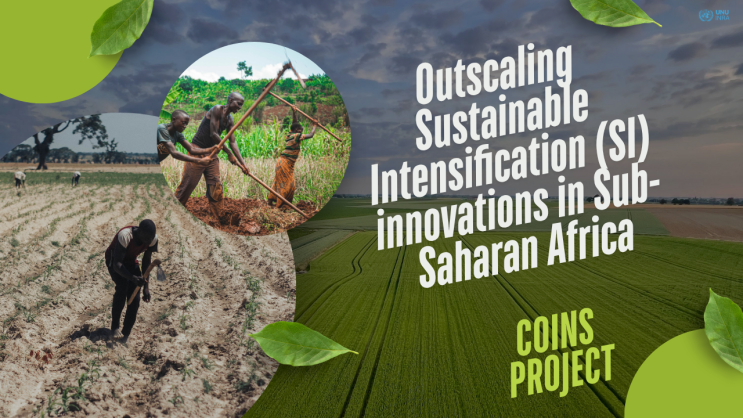
Accra, Ghana – A new report developed under the Co-Developing Innovations for Sustainable Land Management in West African Smallholder Farming Systems (COINS) project has outlined a comprehensive strategy for scaling up sustainable agricultural innovations across Sub-Saharan Africa to strengthen food security, build climate resilience, and restore degraded ecosystems.
The report, Outscaling Sustainable Intensification Innovations in Sub-Saharan Africa, prepared by United Nations University Institute for Natural Resources in Africa (UNU-INRA), comes at a time when the global food system is facing mounting pressure from climate change, biodiversity loss, and a growing population.
According to the 2025 State of Food Security and Nutrition in the World (SOFI) report, between 638 million and 720 million people—about 8.2 percent of the world’s population—continue to experience chronic hunger, despite slight improvements recorded between 2022 and 2024. The situation has been worsened by conflicts, climate shocks and rising food prices, particularly in low-income countries.
In semi-arid West Africa, rapid population growth and widespread land degradation have further intensified food production challenges. The report notes that conventional agricultural intensification practices, including monocropping, excessive tillage and heavy reliance on chemical inputs, have increased yields in the short term but have also depleted soils, reduced biodiversity and strained water resources.
To address these challenges, the report advocates for Sustainable Intensification (SI)—an approach that increases agricultural productivity without expanding farmland or degrading the environment. The strategy promotes knowledge-driven farming through improved crop varieties, integrated soil fertility management, efficient water use and sustainable land management practices.
The report evaluates how successful SI innovations developed through the COINS project can be adapted and implemented across different agroecological zones in Sub-Saharan Africa.
Its primary objectives include identifying regions where sustainable farming practices can be adopted based on crop suitability, climate and landscape conditions; determining the financial, technical and institutional requirements needed for successful expansion; and developing practical implementation strategies with clearly defined responsibilities and financing mechanisms.
Researchers adopted a mixed-methods approach combining portfolio analysis of proven sustainable agriculture practices, stakeholder mapping and funding assessments.
The report highlights a range of proven innovations, including crop-livestock integration, crop rotation, stress-tolerant crop varieties, quality seed systems, integrated soil fertility management, conservation agriculture, soil and water conservation techniques, the System of Rice Intensification, as well as solar-powered and drip irrigation technologies.
These interventions are categorised into investment tiers based on implementation costs, scalability and expected returns to guide governments, investors and development partners in prioritising investments.
Beyond the technologies themselves, the report stresses that successful expansion of sustainable intensification depends on enabling conditions such as access to quality inputs, agricultural extension services, market linkages, rural infrastructure, supportive policies, gender inclusion and strong local institutions.
It also recommends blended financing approaches that combine government investment, donor support, private sector participation, climate finance and community-based funding mechanisms, including microcredit schemes.
To address risks associated with climate variability, markets and institutional capacity, the report recommends promoting drought-tolerant crops, agricultural insurance, farmer aggregation models, demonstration farms and stronger coordination among governments, research institutions, development partners and farmer organisations.
According to the report, scaling sustainable intensification requires evidence-based implementation strategies that match technologies to appropriate agroecological conditions, combine short-term productivity gains with long-term investments, strengthen monitoring systems and embed interventions within durable national institutions.
The report concludes that when these conditions are met, sustainable intensification can move beyond pilot initiatives to become a transformative solution for improving agricultural productivity, strengthening resilience and advancing environmental sustainability across Sub-Saharan Africa.
Researchers say the findings are particularly significant as the world works towards feeding a projected global population of 9 billion by 2050, while achieving the Sustainable Development Goals, including Zero Hunger (SDG 2), Climate Action (SDG 13) and Life on Land (SDG 15).
The COINS project is a multi-stakeholder initiative focused on co-developing sustainable land management innovations for smallholder farming systems in Ghana and Senegal. It seeks to identify practical approaches that enable farmers to sustainably increase agricultural productivity on existing farmland.
Project partners include the University of Ghana, WASCAL, UNU-INRA, Acre Africa, IPAR, DLR, ZALF, UNU-EHS and the University of Bonn.
Source: www.climatewatchonline.com