
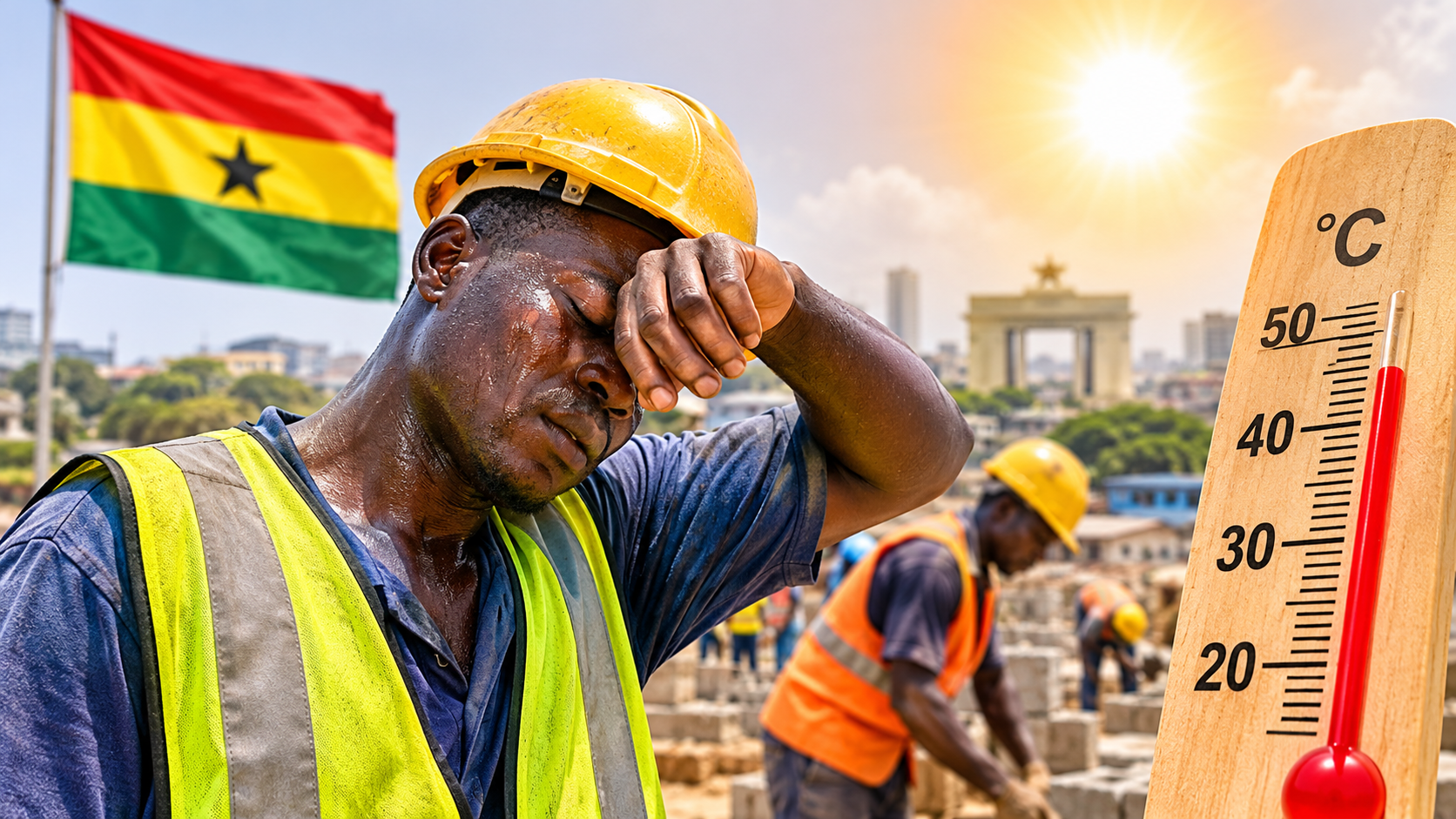
Accra, – Rising temperatures and extreme workplace heat could cost Ghana the equivalent of 550,000 full-time jobs by 2040, threatening livelihoods, productivity and economic growth, a new study by the International Labour Organization (ILO) has warned.
The projected losses form part of a wider climate-related employment crisis facing Ethiopia, Ghana and Senegal, which could collectively lose approximately 2.46 million full-time equivalent jobs and suffer annual Gross Domestic Product (GDP) losses of about US$67 billion by 2040, even under a low-emissions pathway.
The ILO studies warn that workplace heat stress is already disrupting economic activities across the three countries, with the consequences expected to worsen as temperatures rise.
By 2040, reduced working time resulting from heat stress could account for approximately 1.78 million full-time equivalent jobs in Ethiopia, 550,000 in Ghana and 129,000 in Senegal.
The economic consequences could be equally significant. Annual GDP losses are projected at US$33.3 billion in Ethiopia, US$23.2 billion in Ghana and US$10.5 billion in Senegal, compared with the historical reference period.
Ghana already experiencing significant employment losses
The threat is not merely a future projection. The studies show that rising workplace temperatures associated with climate change had already resulted in substantial additional losses of working time and economic output in 2023.
In Ghana, workplace heat stress accounted for the equivalent of more than 345,000 additional full-time jobs lost in 2023 compared with the historical reference period.
Agriculture accounted for approximately two-thirds of the losses, highlighting the vulnerability of workers whose livelihoods depend on physically demanding outdoor activities.
By 2040, the equivalent of 550,000 full-time jobs could be lost in Ghana under the low-emissions pathway, reflecting the growing pressure of extreme heat on working conditions and labour productivity.
Ethiopia recorded more than one million additional full-time equivalent jobs lost to workplace heat stress in 2023, with agriculture accounting for approximately three-quarters of the losses. The figure could rise to about 1.78 million by 2040.
In Senegal, nearly 72,000 additional full-time equivalent jobs were lost in 2023, with the effects particularly concentrated in the services and agriculture sectors. By 2040, the losses could reach approximately 129,000 full-time equivalent jobs.
Agriculture, construction and informal workers face growing risks
Although agriculture and construction are among the most exposed sectors because of their physically demanding activities and high levels of outdoor employment, the effects of workplace heat stress extend across the wider economy.
Manufacturing, transport, trade and services are also vulnerable, while workers and businesses in the informal economy face additional challenges.
For workers who depend on daily earnings, reducing working hours during periods of extreme heat may mean losing essential income. This makes the effects of rising temperatures particularly concerning for vulnerable workers with limited access to social protection.
The findings underscore the growing connection between climate change, occupational health, employment security and economic resilience.
ILO Regional Director for Africa, Fanfan Rwanyindo Kayirangwa, said the findings demonstrate that heat stress has evolved beyond an environmental concern into an immediate threat to jobs, health and economic stability.
“These findings make clear that heat stress is not only an environmental issue. It is already a jobs, health and economic issue. Governments, employers and workers need to act together, combining stronger occupational safety and health measures with social protection, climate adaptation and economic planning.
“Protecting people from heat means protecting livelihoods, enterprises and the resilience of our economies,” she said.
ILO calls for stronger workplace protection and adaptation
To reduce the impact of rising temperatures, the studies recommend practical measures to protect workers and strengthen workplace resilience.
These include adjusting working hours to avoid the hottest periods of the day, introducing appropriate work-rest cycles, providing shade, adequate drinking water and cooling facilities, and strengthening workplace heat monitoring systems.
The ILO also calls for stronger occupational safety and health standards and increased awareness of the symptoms and dangers of heat stress.
Social protection is identified as particularly important for workers in the informal economy, many of whom cannot afford to reduce their working hours without sacrificing essential income.
The recommendations highlight the need for governments, employers and workers to integrate climate adaptation into employment policies, workplace safety measures and economic planning.
The Ethiopia, Ghana and Senegal studies form part of a six-country research initiative that also covers Lebanon, the Maldives and Sri Lanka.
The research was commissioned by the ILO with support from the Climate Vulnerable Forum (CVF) and the Vulnerable Twenty (V20) Group of Finance Ministers, with funding provided through the CVF-V20 Joint Multi-Donor Fund.
Combining climate projections, labour market data and economic modelling, the studies assess the current and future effects of workplace heat stress on productivity, employment and national economies.
The findings present a stark warning for Ghana and other climate-vulnerable economies: protecting workers from extreme heat is becoming increasingly important not only for safeguarding lives and livelihoods but also for sustaining economic growth.
Source: www.climatewatchonline.com