
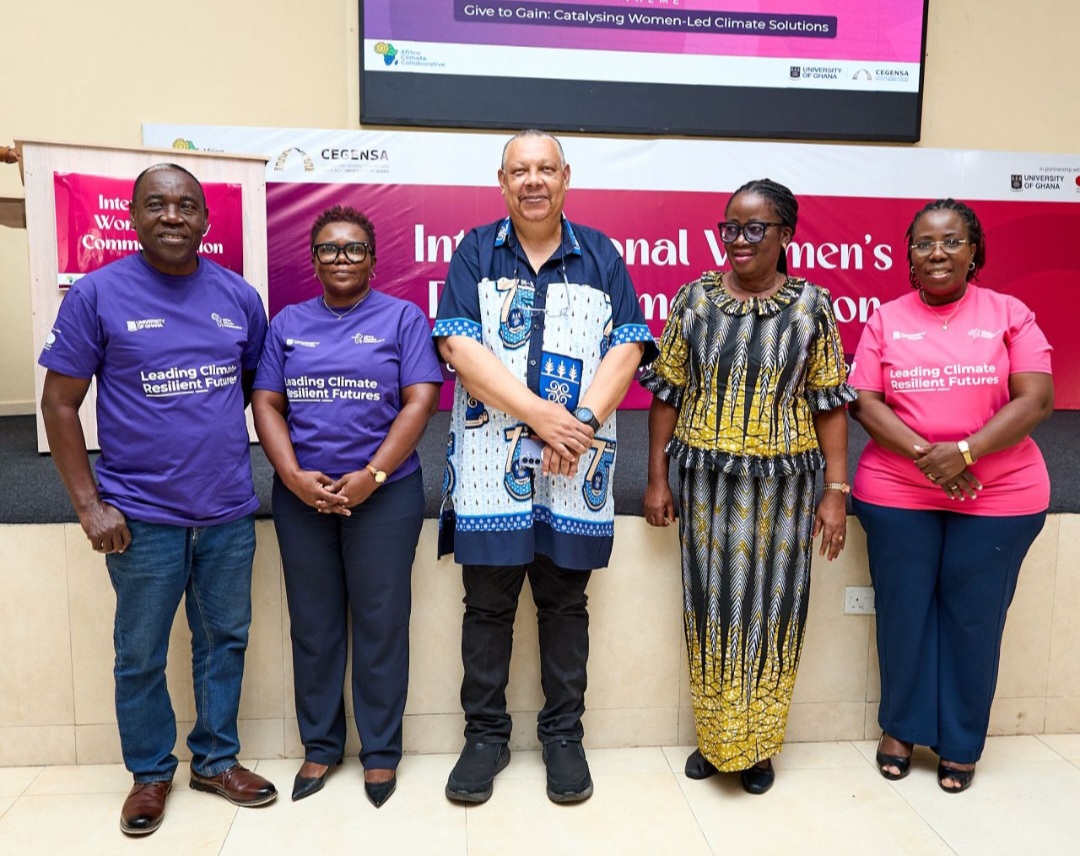
Accra, Ghana— The West African Regional Director of Abantu for Development, Dr. Rose Mensah-Kutin, has called for greater access to climate finance for African countries and increased participation of women in climate action, stressing that effective responses to climate change must be inclusive and gender-responsive.
Speaking at the International Women’s Day 2026 commemoration organised by the Africa Climate Collaborative at the University of Ghana, in partnership with the Centre for Gender Studies and Advocacy (CEGENSA), Dr. Mensah-Kutin said climate change continues to pose a serious threat to livelihoods and development across Africa, making access to climate finance critical for adaptation and resilience-building efforts.
“The issue of climate change is real, and it has to be addressed. The world community has recognized this and established climate finance mechanisms that countries can access. However, it has been difficult for many African countries to benefit from these funds,” she said.

According to her, ongoing international climate negotiations are increasingly emphasizing the need for vulnerable countries, particularly in Africa, to gain fair and equitable access to climate finance if global climate goals are to be achieved.
Dr. Mensah-Kutin noted that women must be recognised as key actors in climate action rather than merely victims of climate impacts.
“We have agreed that when women are actively involved in addressing climate change, the solutions become more relevant and effective. We must ensure that information and data relating to climate change are disaggregated so that the concerns, interests and capacities of both women and men are adequately reflected in climate policies and interventions,” she stated.
She explained that climate impacts are not experienced equally, making it important for policymakers and development practitioners to understand and respond to the different needs of various social groups.
“There are inequalities in every society. We do not all experience situations equally. Therefore, we should not treat everyone as one homogeneous group. We need to identify and address the specific needs and interests of different groups of women and men in order to develop appropriate responses to climate challenges,” she said.
Dr. Mensah-Kutin further underscored the importance of engaging young women in climate action, describing Africa’s youthful population as a valuable asset in advancing environmental sustainability and resilience.
“Africa has a very youthful population. It is important that we recognize the value young women bring to the table and create opportunities for them to contribute. Their involvement can amplify existing efforts and make climate action more relevant to current and future generations,” she added.
She also observed that many development partners and funding institutions now require projects to demonstrate how they address the needs of women, indigenous peoples and other marginalized groups before they can qualify for support.

“There are many funding opportunities that cannot be accessed if issues affecting women, indigenous women and other marginalized groups are not adequately addressed. This has become a requirement, and we must continue to spread this message so that barriers that previously existed can be removed and more women can gain access to resources and opportunities,” she noted.
Dr. Mensah-Kutin expressed optimism that increased awareness and stronger gender-responsive climate policies would improve access to climate resources for women across all age groups, particularly young women, older women and marginalized women who often bear the greatest burden of climate impacts.
She called on governments, development partners, civil society organizations and the private sector to work together to ensure that climate finance reaches vulnerable communities and supports inclusive climate action across Africa.
The event brought together academics, climate advocates, students, gender experts and policymakers to discuss the role of women and girls in advancing climate justice, sustainable development and resilient communities across the continent.
Source: www.climatewatchonline.com