
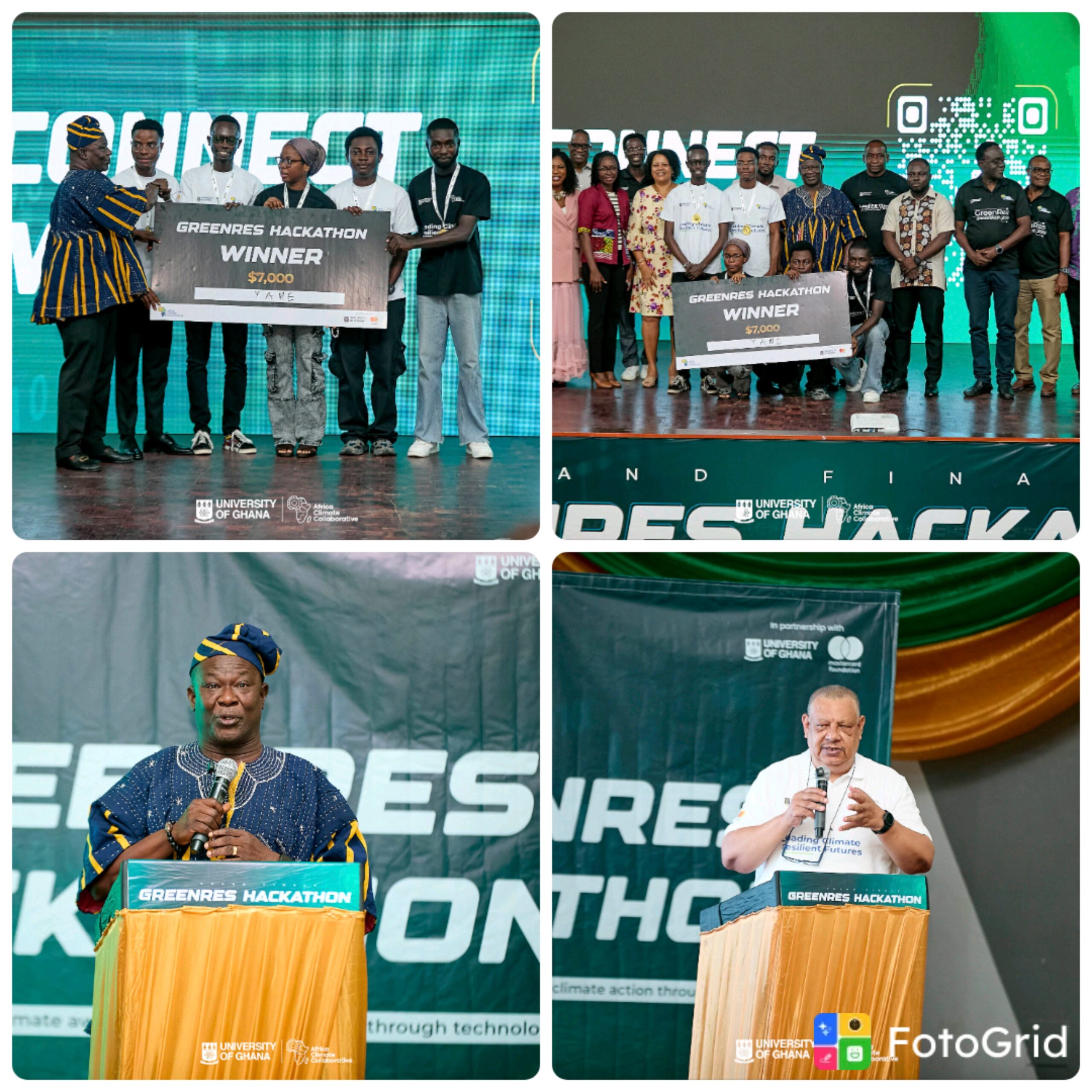
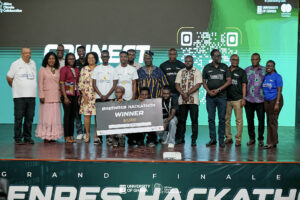
Accra, August 29, 2026— Team Yame has emerged winner of the Grand Finale of the GreenRes Hackathon, taking home US$7,000 for developing an innovative digital platform designed to help young Ghanaians turn climate awareness into practical action.
The Grand Finale was organised by the Africa Climate Collaborative in partnership with the University of Ghana and the Mastercard Foundation, bringing together young innovators to develop technology-driven solutions to climate and environmental challenges.
Team Yame comprised Aamina Hairat Futa, Elvis Kwabena Asare Nkrumah, Alex Njoya and Joshua Awuku Akoey
The winning team’s solution, GreenPath Ghana, is a mobile-first platform designed to help young Ghanaians turn climate awareness into everyday local action.
The platform combines simple reporting tools that can flag issues such as flooding and infrastructure risks with bite-sized climate lessons and community challenges that can be incorporated into users’ daily lives.
Technology for climate action
Speaking after the competition, Elvis Kwabena Asare Nkrumah, a member of Team Yame, said the team was motivated by the opportunity to apply artificial intelligence (AI) and computer science skills to addressing environmental challenges.
“For us, coming together to take on a challenge is something we do as a team,” he said.
He explained that several members of the team had participated in hackathons before, but the GreenRes challenge was particularly appealing because it allowed them to apply their technical knowledge to climate and environmental issues.
“A majority of us are computer science students. We’re in the same class, and so we want to take up challenges in different domains. And climate, or impacting positively our environment, is something we wanted to do,” Mr Nkrumah said.
He said the team also saw an opportunity to leverage AI and digital technology to make climate education more engaging for young people.
Making climate innovation locally relevant
Mr Nkrumah said the team held several brainstorming sessions to determine how to make its application relatable to Ghanaians and local communities.
“We always had the mindset that how do we make our app or our solution connect to the Ghanaians or our local people?” he said.
The team subsequently drew inspiration from childhood experiences and incorporated Ghanaian names and familiar concepts into some of its interactive features.
He said the team’s games included “Clean Chaskili” and “Ecopilo.”
In Ecopilo, users are required to search for materials based on criteria provided by the application and take a screenshot of what they find using a mobile phone.
Mr Nkrumah said incorporating local experiences into the solution helped Team Yame distinguish itself from the other competitors.
“I think this is one of the things which helped us stand out because no team did that, and it made us unique or made us more competitive in the competition,” he said.
EPA backs digital climate communication
Felix Addo Okyere, Director and Head of Climate Transition at the Environmental Protection Agency (EPA), said the growing impacts of climate change required new approaches to public education and awareness.
He said climate change could no longer be treated as a distant or future possibility because its effects were already being experienced.

“Initially, we thought that climate change is a future possibility, but now we have realised that climate change is presently with us,” Mr Okyere said.
He said there was a need to intensify public education, create awareness and build people’s capacity to understand the causes and impacts of climate change and take appropriate adaptation measures.
According to him, stakeholders could not effectively communicate climate issues without embracing recent technologies.
He identified TikTok, Facebook and X as important tools for reaching wider audiences with information about climate change, its causes and impacts.
Mr Okyere said young people were increasingly familiar with digital technologies, computer applications and other online systems, creating an opportunity to direct their interests and skills towards climate action.
“These days are more in tune with the new technologies, the applications, computer applications and other systems, and so we think that if they are able to direct their strength to that direction, that we will be able to catch the young people,” he said.
He stressed the importance of engaging young people through platforms they already use rather than relying exclusively on conventional methods of climate communication.
“We can catch them young, and then for them to appreciate what goes on,” he said.
Technology must serve communities
Mr Okyere said climate technologies should be designed to be interesting, accessible and user-friendly for communities, small towns and cities.
He said the EPA had taken keen interest in supporting innovative approaches that could help communities understand climate change, apply appropriate solutions and become better prepared to adapt to its impacts.
He cautioned that stakeholders risked leaving young people behind if climate communication did not keep pace with technological changes.

“If we have new technologies, we have these new systems, applications, then the young ones would be able to factor themselves into it,” he said.
From competition to implementation
For Team Yame, the competition marks the beginning of the next stage of developing GreenPath Ghana.
Mr Nkrumah said the team would have between one and two months to further develop the application before testing it with real users.
Feedback from users would then be used to improve the platform and ensure that it responds to the needs of its intended audience.
He said the team’s ultimate goal was to bridge the gap between climate awareness and practical action.
“Our main mission on the app is from climate awareness to action,” he said.
The mobile-first platform is expected to give young people a simple way to learn about climate change, identify environmental risks and participate in local solutions.
The reporting component could help users flag issues such as flooding and infrastructure risks, while the educational content and community challenges are intended to encourage sustained engagement with climate action.
Winners rewarded for innovation
The prize structure recognised the top three teams for their climate-focused innovations.
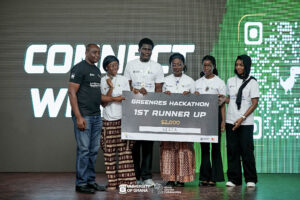
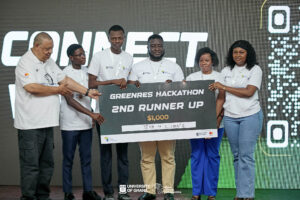
Team Yame, which emerged first, received US$7,000, while Team Verta, the second-place team, received US$2,000.
Team Tech4Climate, which placed third, received US$1,000
The awards are expected to support the winning teams as they continue developing and refining their solutions beyond the hackathon.
The success of Team Yame highlights the potential of young Ghanaian innovators to use artificial intelligence, mobile technology and locally relevant content to address environmental challenges.
For the organisers and partners, the GreenRes Hackathon also provides a platform for young people to move from being recipients of climate information to becoming active developers of solutions to the country’s growing climate challenges.
The Grand Finale ultimately demonstrated how technology, youth innovation and climate education can be combined to move communities from climate awareness to practical action.
Source: www.climatewatchonline.com