
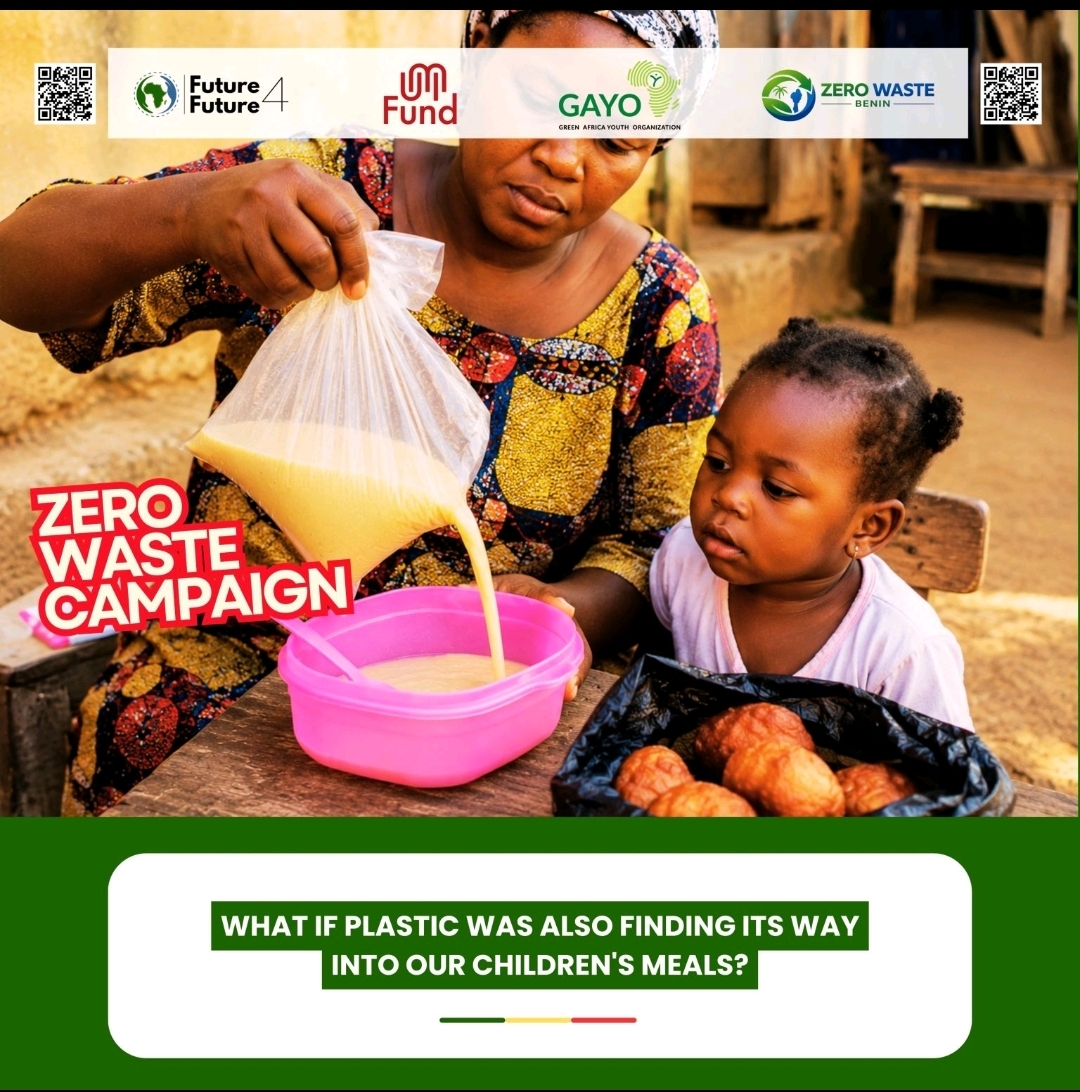
Cotonou Benin–Environmental advocacy group Future for Future has launched a Zero Waste Campaign aimed at reducing plastic-related health risks, urging parents, caregivers, and food vendors to stop serving hot meals and beverages in plastic sachets, bowls, cups, and disposable spoons.
The campaign raises concerns about the widespread practice of packaging porridge, tea, coffee, soups, and other hot foods in plastic containers, warning that heat can cause harmful chemicals and microplastics to leach into food and drinks.
“What if plastic was also finding its way into our children’s meals?” the campaign asks, drawing attention to what it describes as an often-overlooked public health issue.
According to Future for Future, growing scientific evidence suggests that exposing certain plastics to high temperatures increases the migration of chemical compounds and microscopic plastic particles into food and beverages.
The organisation cited findings from the American Academy of Pediatrics indicating that heat can accelerate the release of chemicals such as Bisphenol A (BPA), used in some plastics, and phthalates, additives commonly used to increase plastic flexibility. Both substances have been associated with potential hormonal, developmental, and reproductive health concerns.
Future for Future also referenced research published in Nature Food, which found that polypropylene containers—commonly used for bowls, cups, takeaway containers, and baby feeding products—can release up to 16.2 million microplastic particles per litre when exposed to hot water. At temperatures of about 95 degrees Celsius, the number of particles released can increase to as many as 55 million per litre.
The group further noted that UNICEF has highlighted concerns about children’s exposure to plastic-associated chemicals, including PFAS, bisphenols, and phthalates, warning that infants and young children are particularly vulnerable because their bodies and organs are still developing.
As part of the campaign, Future for Future is encouraging households and food vendors to adopt safer food-handling practices by avoiding the use of plastic sachets and containers for very hot foods and drinks.
The organisation is advocating the use of containers specifically designed for hot food, a reduction in single-use plastic packaging and disposable plastic cutlery, and increased public education on the potential risks associated with heat and plastic contact.
It also called for greater adoption of reusable and environmentally friendly alternatives that protect both public health and the environment.
“Protecting our children also means paying attention to the materials that come into contact with their food,” the organisation stated.
The Zero Waste Campaign forms part of broader efforts by Future for Future to promote sustainable consumption, reduce plastic pollution, and encourage healthier choices for families and communities.
Source: www.climatewatchonline.com