
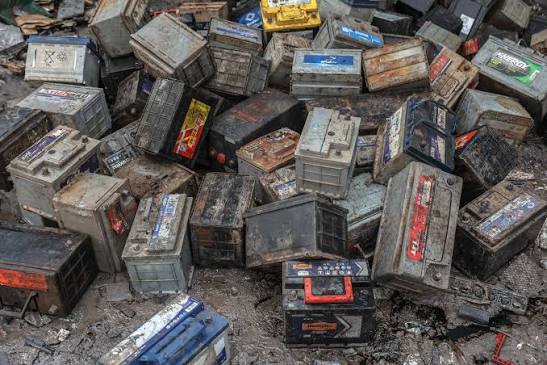
Accra, Ghana — Ghana has become one of West Africa’s leading destinations for lead-acid battery recycling, positioning itself as a growing hub for cross-border waste trade and materials recovery in the sub-region.
Speaking at a panel discussion during a three-day lead poisoning training workshop for journalists organised by Vital Strategies and Bloomberg Philanthropies in Kumasi, Dr. Sampson Atiemo of the Mountain Research Institute said Ghana currently hosts about five large-scale used lead-acid battery recycling plants.
He noted that the country is increasingly receiving used batteries from across West Africa, including Burkina Faso, Mali, Côte d’Ivoire, Niger, Chad, Nigeria and Togo, reflecting its expanding role in regional waste processing networks.
Industry observers say Ghana’s relatively advanced smelting capacity, established logistics systems, and open trade environment have made it an attractive destination for both formal and informal battery traders seeking recycling services.
While some countries in the sub-region, such as Nigeria and Côte d’Ivoire, also operate recycling facilities, stakeholders say Ghana’s infrastructure advantage and processing capacity continue to draw cross-border flows of used batteries.
Growing investment interest in recycling sector
The expansion of the sector has generated increasing interest from investors in waste recovery and secondary materials markets, particularly in lead recovery for industrial and battery manufacturing uses.
Experts say the growth reflects a broader shift toward circular economy models in the region, where waste materials are increasingly viewed as economic inputs rather than environmental liabilities.
However, industry stakeholders caution that sustained growth will depend on Ghana’s ability to strengthen regulatory systems and ensure environmentally sound recycling practices.
Policy frameworks and technical standards
To support safer operations, Ghana has collaborated with international partners, including technical teams linked to Pure Earth and other organisations, to develop standard operating procedures (SOPs) for lead-acid battery recycling.
The guidelines cover the full recycling chain—from collection and transport to dismantling, smelting, and waste disposal—with the aim of reducing environmental contamination and improving operational safety.
For example, collectors are advised against transporting batteries containing residual acid to prevent leakage and exposure, while recyclers are encouraged to implement controlled draining of electrolyte fluids prior to processing.
Balancing opportunity and environmental responsibility
Despite these frameworks, experts say enforcement remains a key challenge, particularly within informal segments of the supply chain where compliance is difficult to monitor.
Stakeholders argue that Ghana’s role as a regional recycling hub presents both an economic opportunity and a regulatory responsibility, especially given the hazardous nature of lead when improperly handled.
They caution that without consistent enforcement and investment in cleaner technologies, the benefits of the sector could be undermined by environmental and reputational risks.
“The industry is growing because the demand is there,” one expert noted. “But the systems that ensure safety and compliance must grow at the same pace.”
Public health and environmental specialists say Ghana’s experience reflects a wider regional reality: as Africa expands its recycling and circular economy sectors, stronger governance will be essential to ensure that economic opportunity does not come at the cost of environmental and human health.
Source: www.climatewatchonline.com