
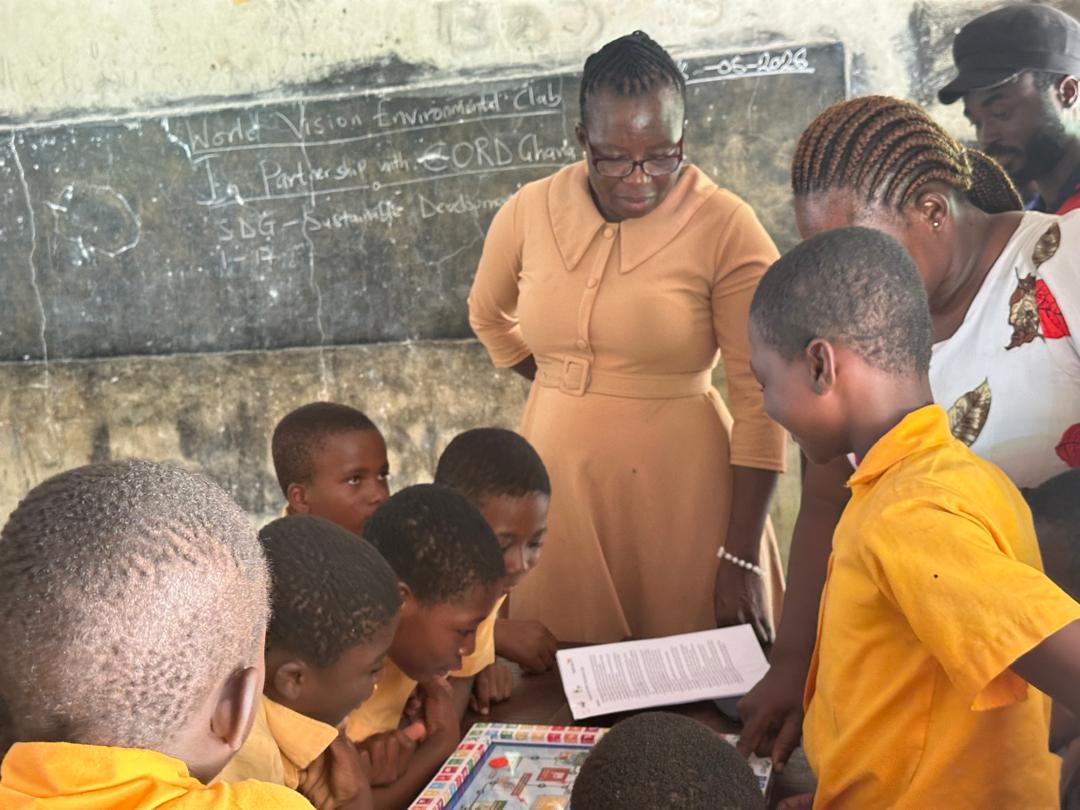
Tamale, Ghana – The Centre for Opportunities and Rural Development (CORD-Ghana), in partnership with World Vision International (WVI), has established and trained Green Schools Eco Clubs in 27 schools across five districts in the Upper East Region to equip students with skills in Farmer Managed Natural Regeneration (FMNR) as part of efforts to restore degraded landscapes and build climate resilience.
The initiative, implemented under the FMNR SEED Project, covers schools in the Miregu, Paga, Chiana, Sirigu and Kandiga districts, bringing together students, teachers and community leaders to promote tree conservation, land restoration and sustainable farming practices.
Speaking at the launch, Dr. Kodimah Siita, Executive Director of CORD-Ghana, said the programme was designed to nurture environmental responsibility among young people, describing schools as the most strategic platform for cultivating a culture of land stewardship in rural communities.
He noted that widespread land degradation and declining tree cover across the project districts had reduced agricultural productivity and threatened the livelihoods of smallholder farmers.
According to Dr. Siita, empowering students with practical knowledge of FMNR would enable them to become active agents of environmental restoration within their schools and communities.
“When we invest in children and young people as environmental champions, we are investing in the future of our land, our food systems and our communities,” he said.
“FMNR is not a complicated technology—it is a practice that every farmer and every student can adopt. These clubs will ensure that knowledge moves beyond the classroom to farms and households.”
Green Schools Initiative Manager at CORD-Ghana, Mr. Courage Kojo Opoku, described the clubs as more than extracurricular groups, saying they represented a movement to transform how young people interact with nature.
He expressed confidence that students would become advocates for protecting trees and restoring degraded lands by encouraging their families to adopt FMNR practices.
“We want every student to return home and explain why trees on family compounds and farms should be protected. Those conversations, repeated across thousands of households, can help reverse land degradation,” he said.
Farmer Managed Natural Regeneration is a low-cost land restoration approach that promotes the protection and management of naturally regenerating trees and shrubs from existing root systems. The practice has been widely recognised for improving soil fertility, reversing land degradation and enhancing food security, particularly in dryland farming communities.
FMNR Programme Manager at World Vision Ghana, Mr. Samuel Abasiba, said restoring degraded landscapes required long-term commitment and that educating school children was critical to sustaining environmental conservation efforts.
“FMNR works because it builds on nature’s own regenerative capacity. By teaching children to nurture regenerating trees today, we are helping secure their families’ harvests for the future,” he said.
Mr. Abasiba noted that World Vision Ghana’s FMNR programme had already delivered measurable improvements in land restoration and rural livelihoods across Northern Ghana, adding that integrating the Green Schools Initiative into the FMNR SEED Project would strengthen those gains by creating a new generation of environmental advocates.
Each participating school has established a Green Schools Club comprising elected student leaders, a teacher patron and a structured programme of activities, including tree nursery development, FMNR demonstration plots, environmental awareness campaigns, LEAN Game advocacy sessions and community outreach activities.
The project targets the five districts because of their high levels of land degradation and deforestation, challenges that have intensified the impacts of erratic rainfall, declining soil fertility and reduced agricultural productivity.
Students who participated in the initial training expressed enthusiasm about the programme, saying it had improved their understanding of the relationship between trees, rainfall and food security. Many pledged to share FMNR knowledge with their families and encourage sustainable land management practices in their communities.
CORD-Ghana and World Vision International said they would continue to monitor the Green Schools Clubs, provide additional training for teacher-advisors and document lessons from the initiative to support future expansion of the FMNR SEED Project as part of wider efforts to restore degraded farmlands and strengthen climate resilience across Northern Ghana.
Source: www.climatewatchonline.com