
By: Green Africa Youth Organization (GAYO) Uganda
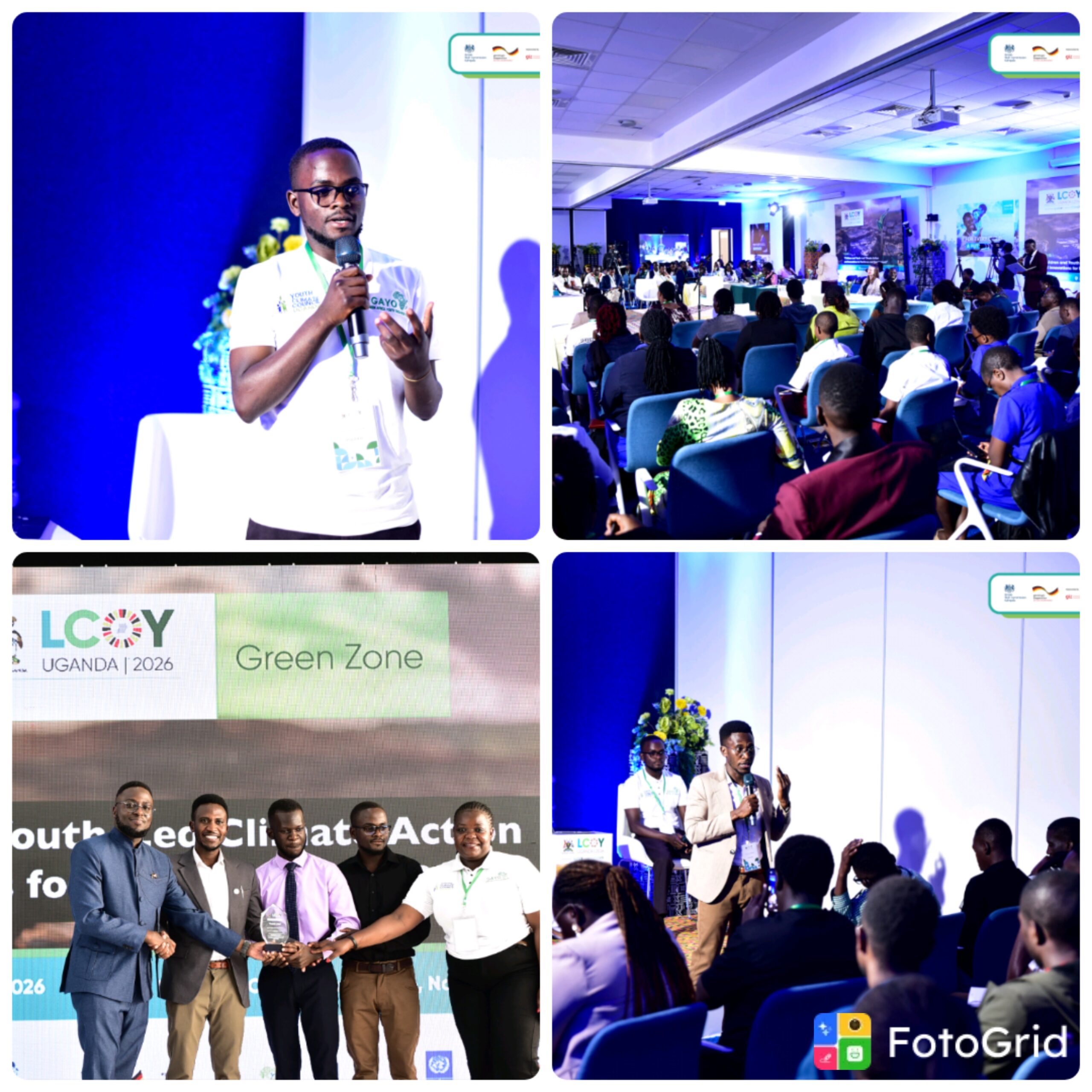
For several days, young people from across Uganda gathered at LCOY Uganda 2026 under the theme “Children and Youth-Led Climate Action and Innovations for Resilience and Development.” More than a conference, LCOY Uganda 2026 created a space for young people to connect, exchange ideas, engage decision-makers, showcase innovations, and shape conversations around Uganda’s climate future.
For Green Africa Youth Organization (GAYO) Uganda, the gathering was an important opportunity to contribute to a national youth climate platform while bringing our experience in zero waste, circular economy, youth leadership, climate communication, and community-led climate action into the wider conversation.
Our participation was not simply about being present. It was about contributing to the conversations, creating spaces for practical solutions, building partnerships, and ensuring that issues affecting young people and communities remain central to climate action.

A platform for youth voices and climate action
LCOY Uganda 2026 brought together young climate leaders, government representatives, development partners, civil society organizations, innovators, researchers, private-sector actors, and other stakeholders to explore the challenges and opportunities facing Uganda’s climate agenda.
The opening day set the tone for the conference with high-level discussions around Uganda’s climate commitments, including NDC 3.0 and the road to COP31. The conversations provided an opportunity to examine what Uganda’s updated climate commitments mean for young people and how youth can contribute to their implementation.
For GAYO Uganda, these conversations reinforced a principle at the heart of our work: young people should not only be consulted about climate action; they should have meaningful opportunities to shape, implement, and monitor it.

The discussions also moved beyond policy to explore practical areas such as climate finance, entrepreneurship, access to information, climate communication, children’s participation, and the role of young innovators in developing solutions.
Bringing circular economy and zero waste into the conversation
One of GAYO Uganda’s key contributions to LCOY Uganda 2026 was our engagement around circular economy and zero waste solutions.
Together with the Youth Climate Council Uganda, GAYO Uganda convened a side event titled:
“Turning Waste into Wealth: Circular Economy Innovations for Climate Action.”
The session created space to explore how waste can be reimagined—not simply as something to be disposed of, but as a resource that can generate economic opportunities, create green jobs, support sustainable livelihoods, and contribute to climate action.
The discussion brought attention to practical approaches including resource recovery, reuse, recycling, community-based waste management, circular entrepreneurship, and youth-led innovation.
This conversation was particularly important because waste and climate change are deeply connected. The way societies produce, consume, and manage resources has implications for greenhouse gas emissions, pollution, public health, livelihoods, and the resilience of communities.
For GAYO Uganda, the side event was an opportunity to bring the organization’s experience in zero waste and circular economy approaches into a wider national youth climate dialogue.
It also reinforced our belief that young people should be positioned not only as beneficiaries of green economic opportunities but as innovators, entrepreneurs, advocates, and leaders of the circular transition.
Connecting agriculture, livelihoods and the circular economy
Our engagement also extended into conversations on agriculture and sustainable livelihoods.
At the session on “Advancing Circular and Regenerative Agriculture for Women and Youth Across Uganda,” discussions explored how circular economy principles can be applied to agricultural systems to improve resource efficiency, strengthen resilience, restore ecosystems, and create opportunities for young people and women.
The conversation demonstrated that circularity is not limited to waste management. It can also influence how food is produced, how agricultural resources are used, how value is retained within communities, and how livelihoods can become more resilient to climate change.
For young people, these approaches open up opportunities across agriculture, innovation, technology, waste recovery, green entrepreneurship, and sustainable value chains.
This connection between climate action, livelihoods, agriculture, and circularity is critical to building solutions that respond not only to environmental challenges but also to the economic realities faced by communities.
Beyond the sessions: Building connections and partnerships
One of the most valuable aspects of LCOY Uganda 2026 was the opportunity to connect with people and organizations working across different parts of the climate landscape.
The conference demonstrated that climate action cannot be delivered by one organization, sector, or group alone. It requires collaboration between young people, communities, government, development partners, civil society, researchers, businesses, and financial institutions.
For GAYO Uganda, these connections are an important part of strengthening our work and identifying opportunities to take promising ideas beyond conference discussions and into communities.
The conversations around climate finance were particularly relevant. Young people are developing innovative solutions, but many continue to face barriers in accessing the resources needed to take those ideas from concept to implementation.
Creating stronger links between young innovators and climate finance institutions is therefore an important part of building a green economy that is inclusive and youth-driven.
From conversations to action
Throughout LCOY Uganda 2026, one message continued to emerge: dialogue must lead to action.
The value of a youth climate conference is ultimately measured not only by the quality of the conversations held during the event, but by what happens after participants return to their communities and organizations.
For GAYO Uganda, this means continuing to strengthen youth-led initiatives, support circular and zero waste solutions, promote climate literacy, create opportunities for young people to participate in decision-making, and build partnerships that enable practical climate solutions to grow.
It also means continuing to create spaces where young people can move from being participants in climate processes to becoming co-creators and implementers of climate solutions.
A recognition of partnership
As LCOY Uganda 2026 came to a close, GAYO Uganda was honoured to receive recognition as one of the partners supporting the conference.
The award was a meaningful moment for the organization,not simply because of the recognition itself, but because it represented the value of partnership and collective effort in advancing youth climate action.
The recognition reflects the contributions of everyone who worked behind the scenes and participated in the various engagements: our team, partners, youth leaders, innovators, community actors, and the wider climate movement.
It is also a reminder that meaningful climate action is built through collaboration.
For GAYO Uganda, being part of LCOY Uganda 2026 was an opportunity to contribute to a platform that brings together different perspectives while amplifying the role of young people in shaping Uganda’s climate future.
Looking ahead
As the curtains came down on LCOY Uganda 2026, the work did not end.
The ideas shared, partnerships created, and lessons learned now need to move beyond the conference halls and into communities, institutions, policies, businesses, and youth-led initiatives.
GAYO Uganda will continue to champion approaches that place young people at the centre of climate solutions while advancing zero waste, circular economy, green livelihoods, climate innovation, and meaningful youth participation in climate governance.
Our experience at LCOY Uganda 2026 reaffirmed something we strongly believe:
Young people are not waiting for the future to arrive. They are already designing, testing, communicating, and implementing the solutions that will shape it.
The conversations have started. The partnerships are growing. The recognition is encouraging.
Source: www.climatewatchonline.com